Superpowers 5 is out today.
Visual Brainstorming #
By far, my favorite new feature is the "Visual Brainstorming" companion tool, which grew out of my frustration with the ASCII art that Claude usually generates when you ask it anything about design or UX. I found myself asking Claude, over and over, "Hey, why don't you write that out as HTML so I can see what you're talking about."
It took me far too long to remember what might be the most important mantra of agentic coding: "Why am I doing this?"
And so now, if your agent has Superpowers and thinks that it has something for you to see, it'll prompt you:
Some of what we'll be working on might be easier to explain if I can show it to you in a web browser. I can put together mockups, diagrams, comparisons, and other visuals as we go. This feature is still new and can be token-intensive. Want to try it? (Requires opening a local URL)
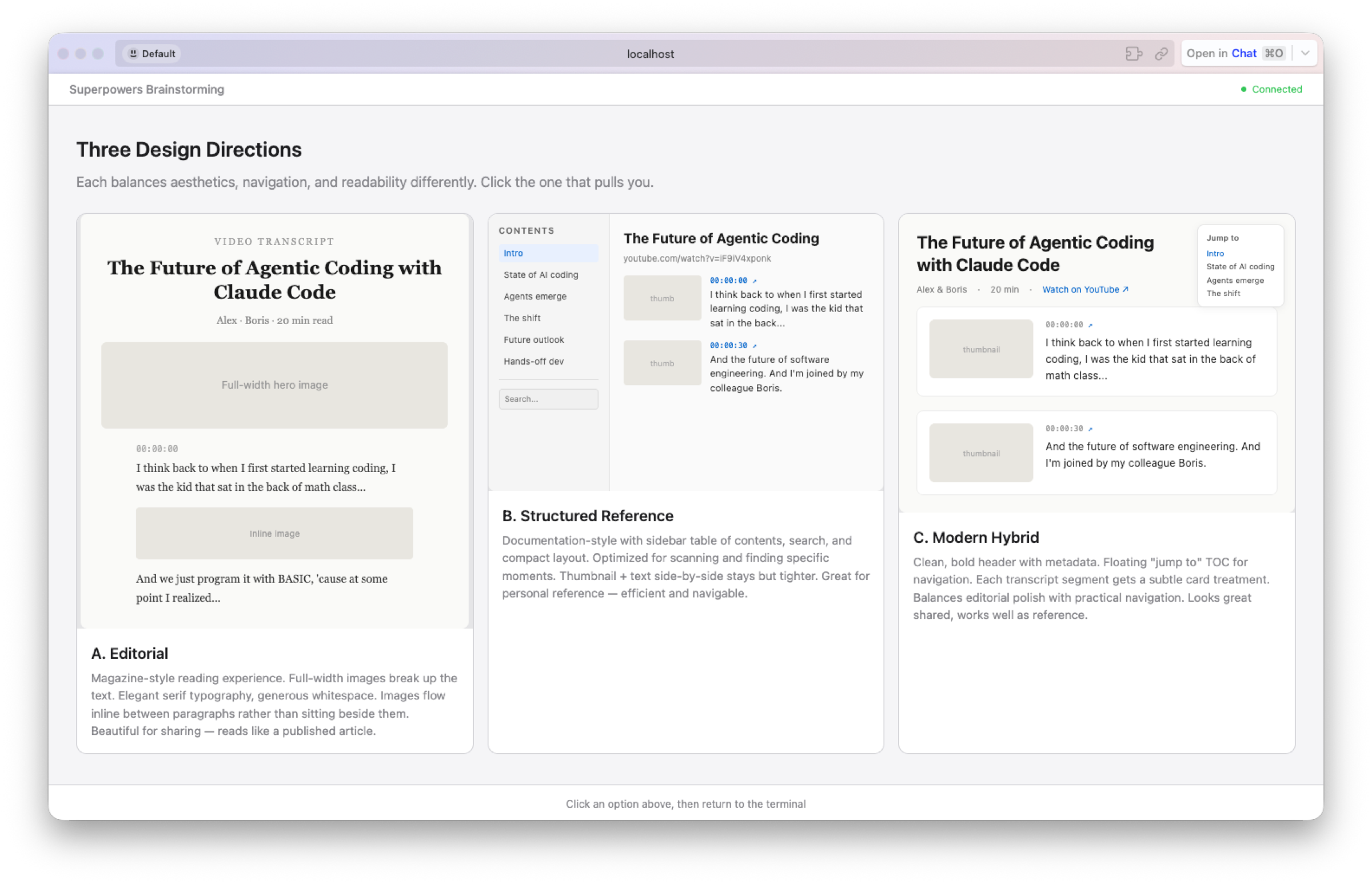
As an example of how this works, I fired up an instance of Claude with Superpowers 5 to clean up the rendered webpages from Youtube2Webpage. Until quite recently, Youtube2Webpage was, by far, my most popular GitHub repo. Thanks to all of you, that is no longer the case.
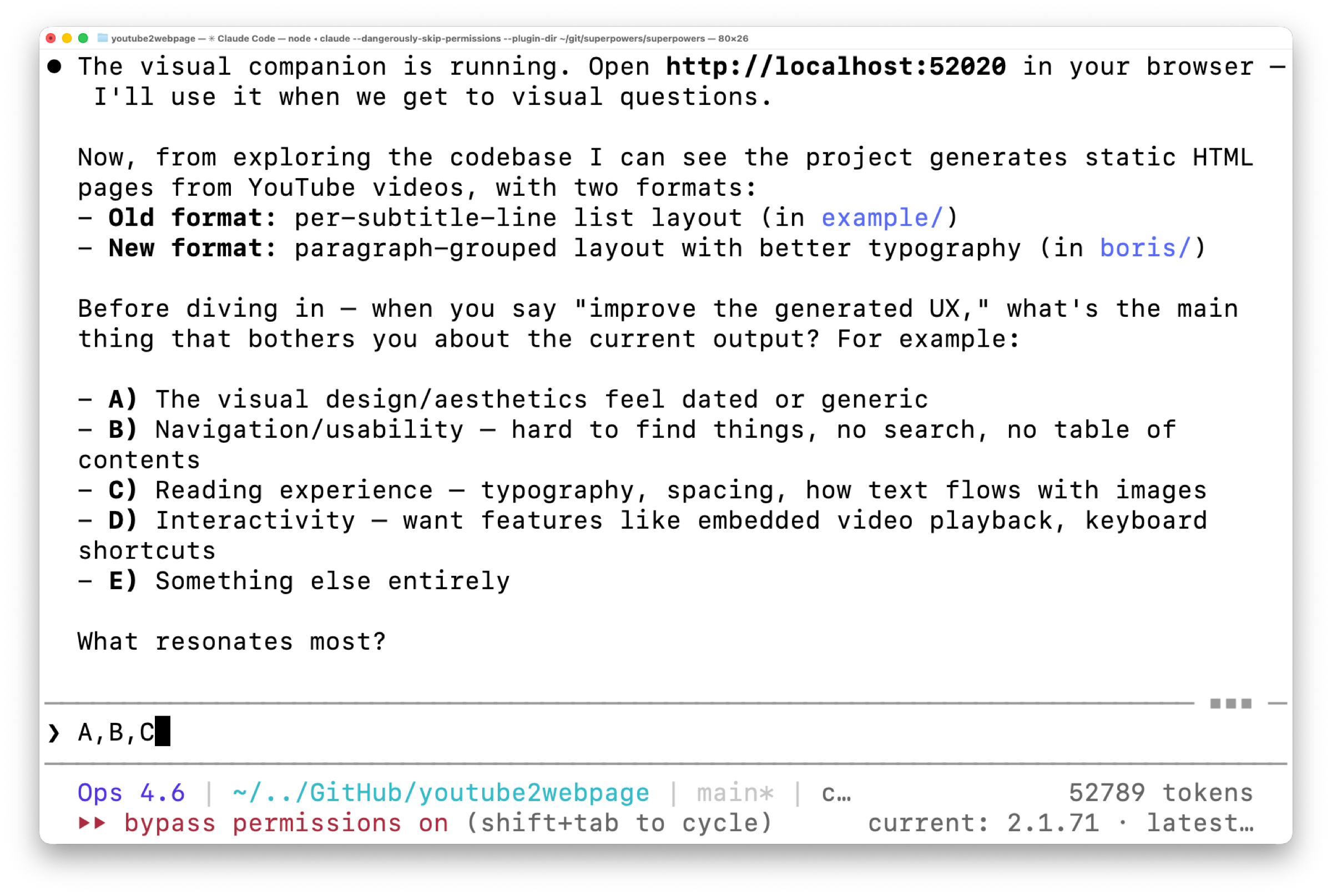
And then after a little more back and forth in the terminal, Claude told me to go look at the browser.
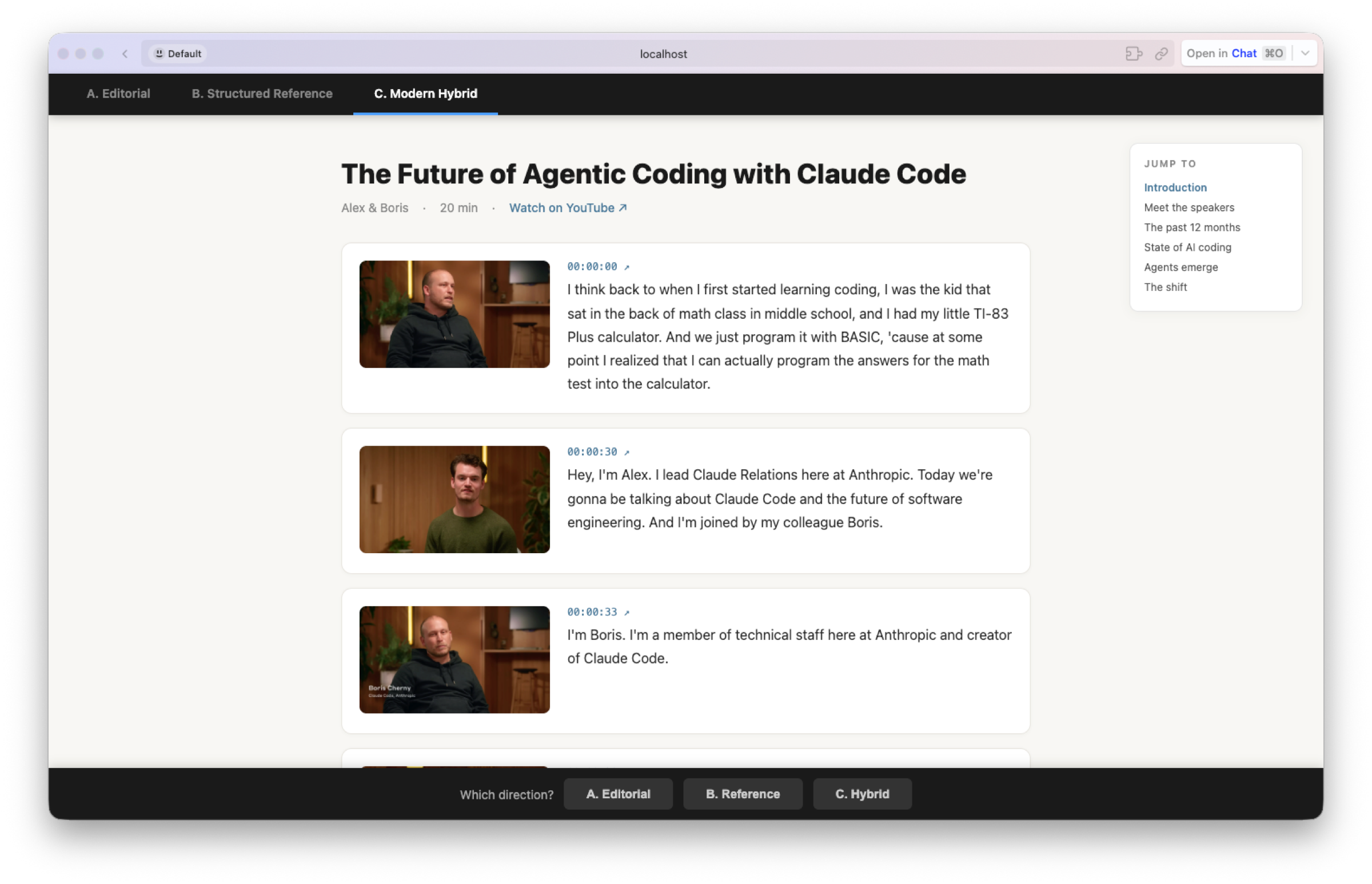
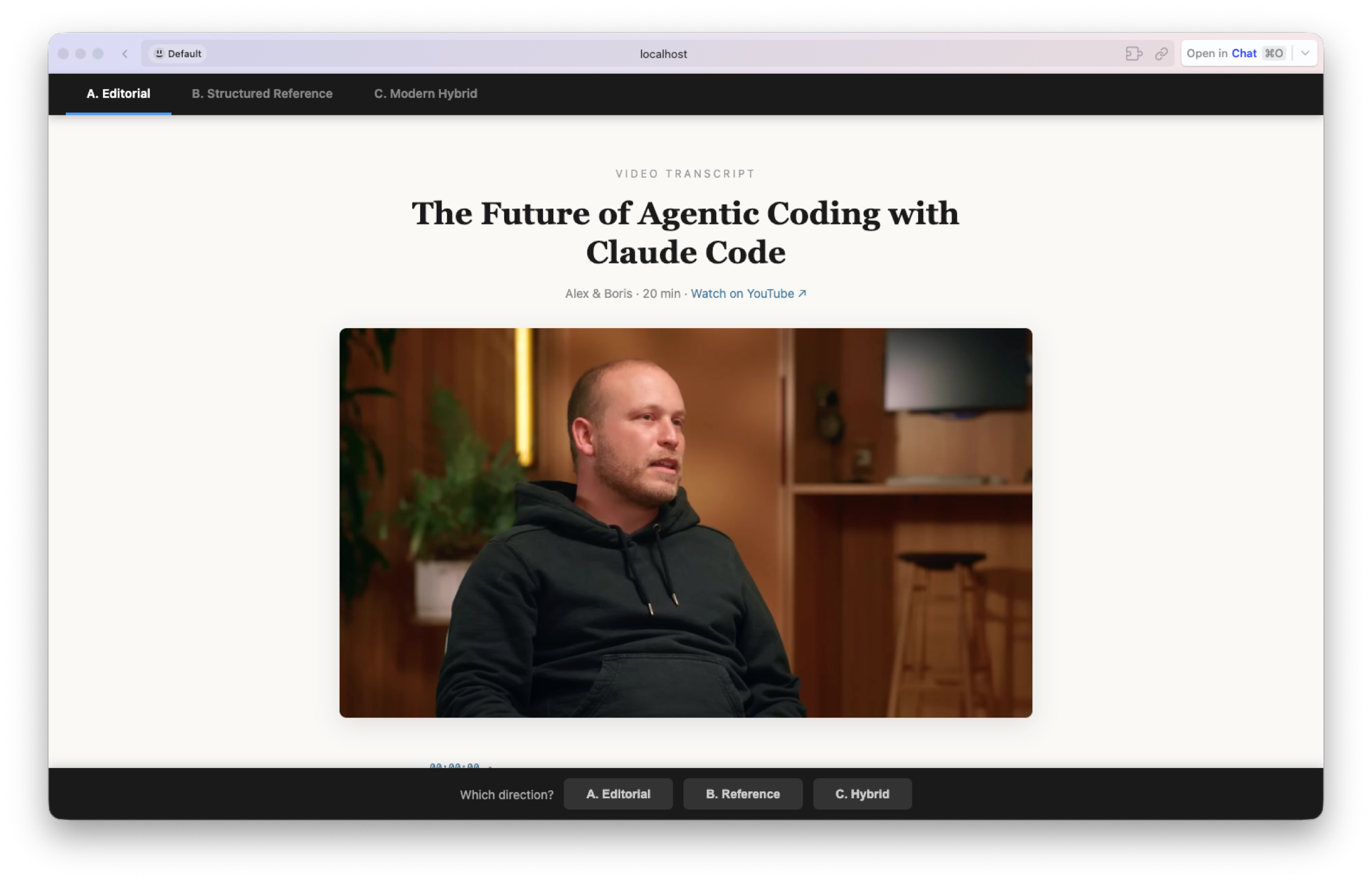
Visual Brainstorming has been in our dev branch for a couple months now. Since it landed, Claude Code's built in "AskUserQuestion" tool has grown support for showing ASCII-art diagrams attached to choices:
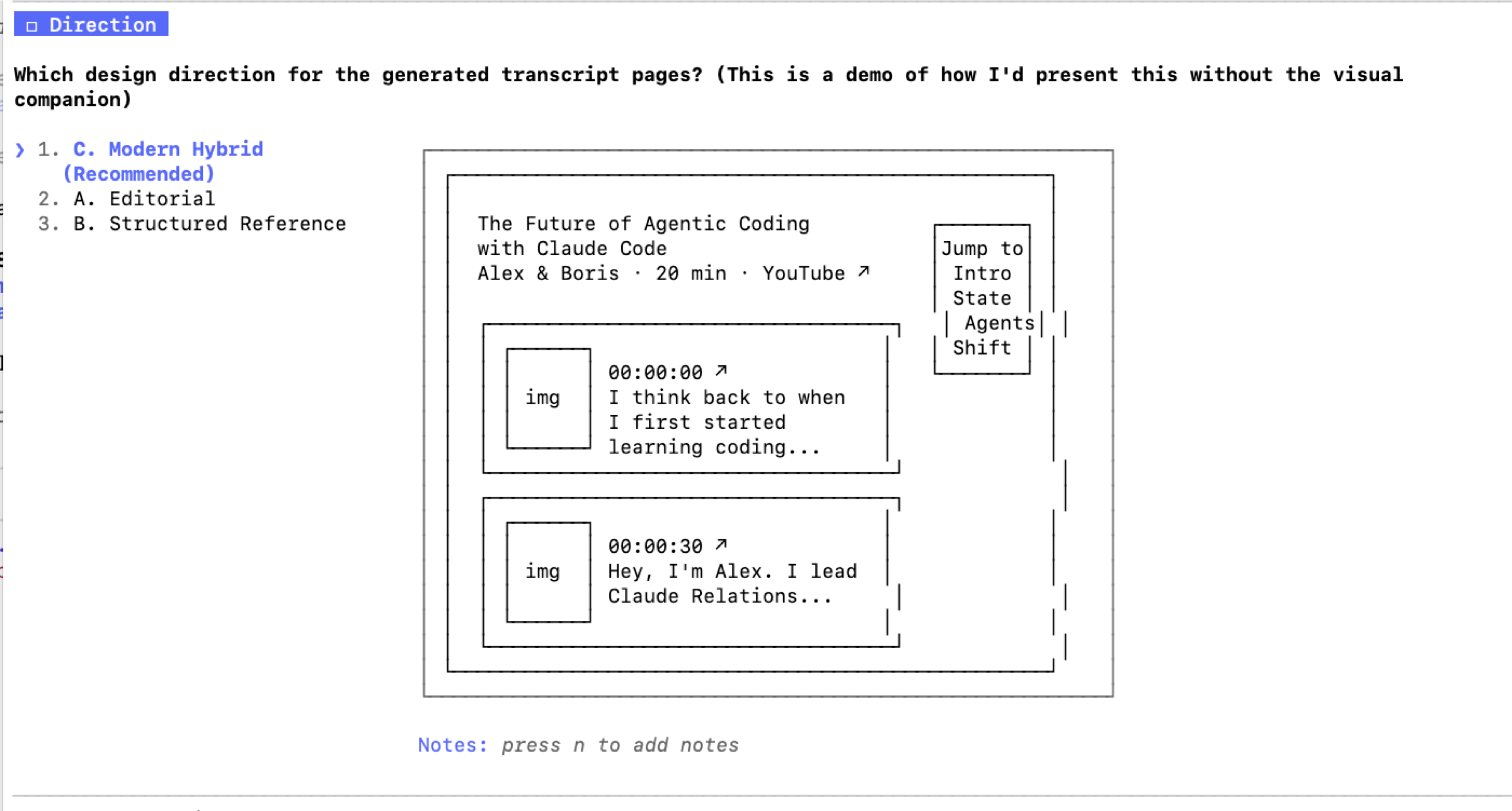
ASCII art is great for communicating basic intent, but when you're working anything complicated, getting out of the terminal can make it much easier to communicate about what you're doing.
As an example, I tried to get Claude to help with some brand/logo ideation for Prime Radiant.
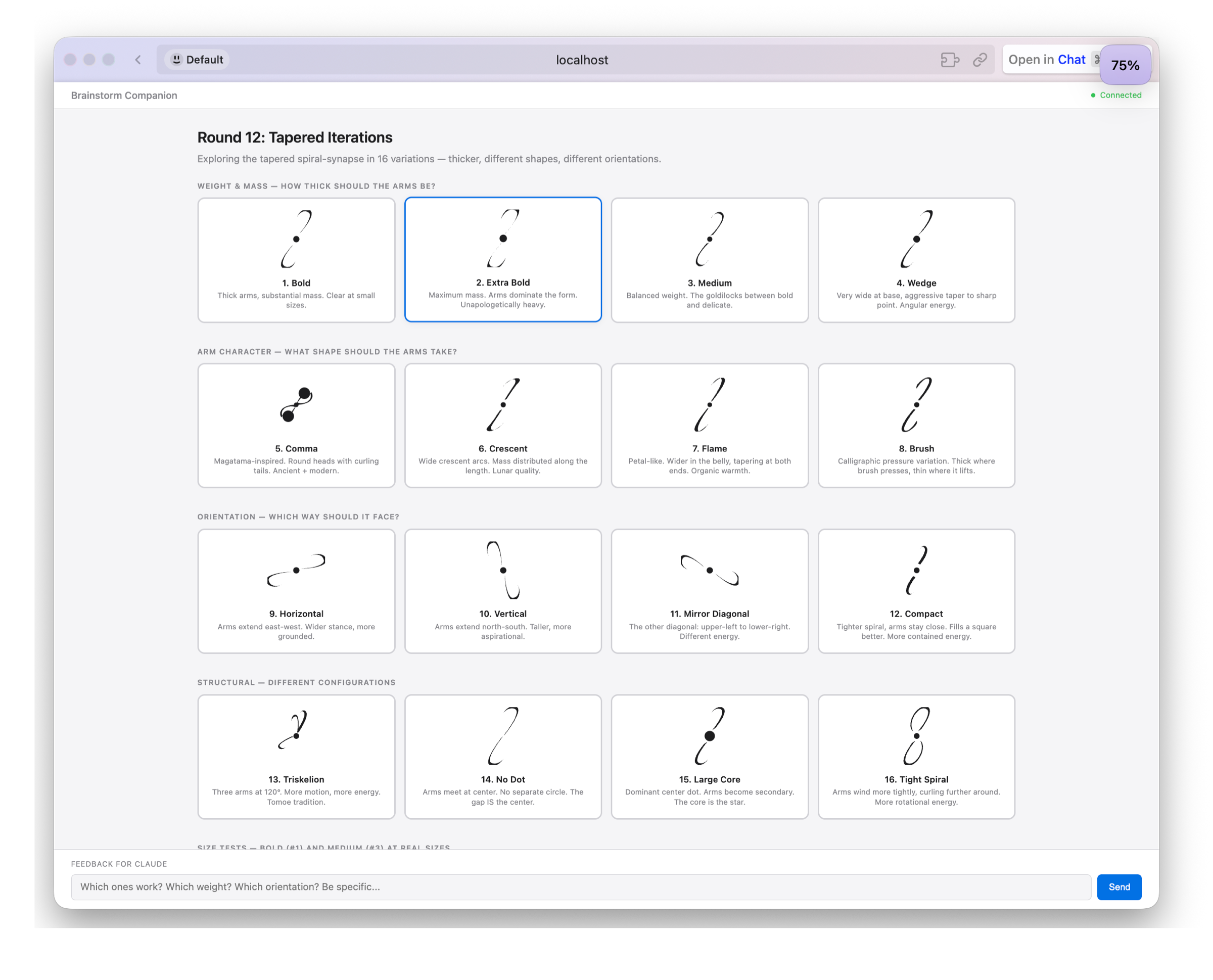
You can imagine what kind of a disaster that would have been in ASCII art.
Behind the scenes, we're spinning up a web server that loads chunks of HTML written by your agent off of disk and a little bit of client-side javascript that returns clicks and feedback from the browser as you interact with it.
Visual Brainstorming is mostly tested in Claude Code and Codex, but should work in most agents.
Spec Review #
One of the most important workflow improvements in 5.0 is a new 'spec review' loop.
Starting with Claude Opus 4.5 or so, I've been catching my agents leaving some steps in longer spec and planning docs as "TBD" or "Fill this in later."
Using specs and plans with "TBD" sections goes over just about as poorly as you'd imagine it would.
The solution to something like this is to run the exact same playbook we're running everywhere else: an adversarial review loop. Now, after Superpowers finishes planning, it kicks off a subagent that reads the plannning docs for sanity and completeness. It's not a panacea and not a substitute for actually glancing at at least the "spec" doc yourself, but does seem to lead to a dramatic improvement in planning document quality.
Subagent Driven Development #
Until now, Superpowers has always offered the user the choice of Subagent Driven Development or having the human partner open up another session and run a plan one chunk at a time. That choice dates from a time when subagents were new and, well, I didn't trust them.
Over the past 5 months, it's become crystal clear to me that the Subagent Driven Development workflow is dramatically more capable and effective than the old way. If your coding agent supports subagents, Superpowers will use Subagent Driven Development. If it doesn't support subagents, it will warn you that a harness that supports subagents will do a better job and then it'll do the best it can to work the full plan in a single session.
In harnesses like Claude Code that are capable of choosing which model to use for a subagent, we now instruct the agent to use the cheapest model capable of doing a given task. With the detailed plans produced through the brainstorming + writing plans process, it's not uncommon to be able to use Claude Haiku for implementation. Along with that, I've tuned Subagent Driven Development a little bit to allow the subagents to better communicate if they're out of their depth and need a hand.
Software engineering #
As it becomes more realistic to build larger and larger projects with Superpowers, I've found it helpful to add some additional general software engineering guidance to the core skills. I asked Claude what it understood about these changes and this is what it had to say:
  A new section in brainstorming explicitly teaches unit decomposition:
  - Each unit should have one clear purpose, well-defined interfaces, independently testable
  - "Can someone understand what a unit does without reading its internals? Can you change the internals without breaking consumers?"
  - Files growing large is treated as a design smell, not just a style issue

  This same principle cascades through the pipeline:
  - Writing-plans now requires a File Structure section before task decomposition — deciding what files exist and what each one owns
  - Implementer prompt tells workers to follow the planned file structure and escalate if a file outgrows its intended scope
  - Code quality reviewer now checks for single-responsibility violations and file size growth

  This is interface-driven design pushed all the way from spec through implementation and review.
One thing that Claude neglected to mention is that brainstorming is now on the lookout for projects that it considers "too big" and will interactively work with you to break them down into more manageable pieces. You'll likely see even more aggressive work on task decomposition in a future release.
Other changes #
Documentation location #
As of 5.0, Superpowers no longer defaults to writing its specs and plans in docs/plans, instead preferring docs/superpowers/specs and docs/superpowers/plans.
Local instructions #
Superpowers now explicitly instructs your coding agent to prefer direct instructions from you, your CLAUDE.md or your AGENTS.md to Superpowers internal instructions. If you want to customize Superpowers behavior, it should now be as simple as a line in the right document.
Codex and subagents #
OpenAI Codex has recently added support for subagents. It's been a little bit of a moving target, but generally I've been finding that Codex rigorously follows all instructions from Superpowers. And that includes when subagents get ahold of the using-superpowers skill and decide to start brainstorming and delegating all their work to subagents, occasionally recursively. Superpowers 5 adds a mitigation against this behavior.
Deprecating /commands #
The slash commands that have been in Superpowers since the beginning date from a time when Claude Code didn't have native support for skills. The original prompts that became the brainstorm, writing-plans, and executing-plans skills lived in slash commands. As skills have evolved, Claude Code treats skills as slash commands and Claude is increasingly confused by the 'old' slash commands. As of 5.0, the three slash commands we ship now announce that they've been deprecated. They'll go away in a future release.
In general, you should be able to just describe your intent to your coding agent and Superpowers + the native skills system should start using the right skills. (My default smoke test for Superpowers is to open up a coding agent and type "Let's make a react todo list." If the agent starts coding, I failed. If it kicks off the brainstorming skill, then the right thing is happening.)
Try it out #
Superpowers 5 is out now. If you're using a harness with a plugin system like Claude Code or Cursor, it should auto-update sometime over the next day or two. If you're using Superpowers in another tool with a direct installation, you may need to git pull or instruct your agent to do a fresh install.